India, Pakistan, and the Bomb by Ganguly Sumit; Kapur S. Paul;
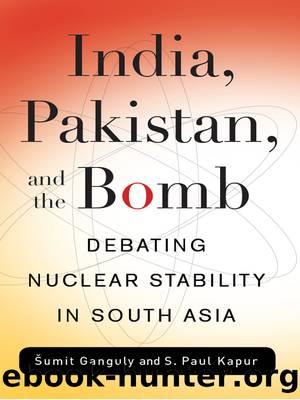
Author:Ganguly, Sumit; Kapur, S. Paul;
Language: eng
Format: epub
Tags: Political Science/International Relations/General
Publisher: Columbia University Press
Published: 2011-11-15T16:00:00+00:00
S. PAUL KAPUR
A number of observers suggest that recent improvements in Kashmir, and in broader Indo-Pakistani relations, have resulted from the pacifying effects of nuclear deterrence. V. R. Raghavan, for example, argues that “a peace process with Pakistan on Kashmir has commenced and will continue. The conflict stabilization and the future resolution of the dispute could well be attributed to deterrence operating in the region.”22 In truth, however, improvements in Indo-Pakistani relations have not resulted primarily from nuclear deterrence. The Pakistanis reduced their support for anti-Indian militancy for three main reasons. First, in the wake of the September 11, 2001 terrorist attacks, the American government realized that Islamic terrorism was a global problem with direct implications for the United States’ own security. The Americans also decided that they needed Pakistan to serve as a leading partner in their new antiterror coalition. Thus, while the United States had previously turned a blind eye toward Pakistani support for militancy in South Asia, it was no longer willing to do so. In order to serve as an ally in the U.S. antiterrorism effort—thereby avoiding the United States’ wrath and enjoying its considerable financial largesse—the Pakistanis were obliged to reduce support for Islamic insurgents in Kashmir, in some cases going so far as to outlaw militant groups.23
Second, Pakistani cooperation with the United States alienated Islamic militant organizations, which branded Musharraf a traitor. These groups subsequently turned against the Pakistani government and attempted on multiple occasions to assassinate Musharraf.24 This led the government to take further measures against the militants, as a matter of self-preservation.
Third, Pakistan’s internal security situation has deteriorated badly, with militant groups challenging the central government for control in areas such as the Northwest Frontier Province and Federally Administered Tribal Areas. The militants, in league with terror organizations such as al-Qaeda, have launched a wave of terrorist violence that has wreaked havoc not just on NWFP and FATA but also on major cities such as Karachi, Lahore, and Islamabad. Terrorist attacks on noncombatant targets in Pakistan more than doubled between 2006 and 2007, and deaths from terrorist violence increased fourfold, with 1,335 people killed.25 In response, Pakistan has deployed roughly 100,000 troops to the tribal areas, where they have so far been largely ineffectual in quashing the militants.26 Islamabad views the situation as an existential threat to the Pakistani state, and the Gilani government announced that defeating the terrorists would be the top priority of its first hundred days in office.27 This struggle against internal threats has diverted Pakistani attention and resources from the Kashmir conflict and impeded Pakistan’s ability to pursue its low-intensity conflict strategy against India. As Gurmeet Kanwal argues, Pakistan is “unable to fight simultaneously on three fronts—a proxy war against India, the Al-Qaeda-Taliban combine in its North West Frontier Province and vicious internal instability.”28 As a result, the Pakistanis have been forced to scale back their involvement in militant operations against Indian Kashmir. Pakistan’s reduced support for anti-Indian militancy, then, is not primarily the product of nuclear deterrence.
Download
This site does not store any files on its server. We only index and link to content provided by other sites. Please contact the content providers to delete copyright contents if any and email us, we'll remove relevant links or contents immediately.
The Vikings: Conquering England, France, and Ireland by Wernick Robert(84578)
Ali Pasha, Lion of Ioannina by Eugenia Russell & Eugenia Russell(40380)
The Conquerors (The Winning of America Series Book 3) by Eckert Allan W(39021)
The Vikings: Discoverers of a New World by Wernick Robert(37048)
Cecilia; Or, Memoirs of an Heiress — Volume 1 by Fanny Burney(32718)
Cecilia; Or, Memoirs of an Heiress — Volume 2 by Fanny Burney(32085)
Cecilia; Or, Memoirs of an Heiress — Volume 3 by Fanny Burney(32063)
Empire of the Sikhs by Patwant Singh(23199)
The Secret History by Donna Tartt(19466)
Hans Sturm: A Soldier's Odyssey on the Eastern Front by Gordon Williamson(18723)
Cat's cradle by Kurt Vonnegut(15552)
Pimp by Iceberg Slim(14789)
Sapiens: A Brief History of Humankind by Yuval Noah Harari(14552)
Norse Mythology by Gaiman Neil(13564)
Talking to Strangers by Malcolm Gladwell(13535)
Leonardo da Vinci by Walter Isaacson(13505)
4 3 2 1: A Novel by Paul Auster(12609)
Underground: A Human History of the Worlds Beneath Our Feet by Will Hunt(12229)
The Radium Girls by Kate Moore(12177)
